Sea Conditions And Cancellations For Lagos Grotto Trips
Sea conditions, not a fixed calendar, decide whether a grotto boat leaves Lagos Marina. Here is what cancels a trip, what the rules say, and what happens to your booking.
Short answer
A Lagos grotto trip is cancelled when the skipper judges the swell, tide or wind unsafe, when IPMA has a yellow maritime-agitation warning in force, or when too few guests book. All 25 trips listed here carry free cancellation up to 24 hours before the start, but no operator promises a weather refund timeline.
A cancelled grotto trip is rarely a surprise to the people running it. The skippers at Lagos Marina read the same sea forecast every morning that the national maritime authority publishes, and the rules that bind them are written into municipal editais and national registration schemes, not into a brochure promise. If your search brought you here because a Lagos boat was cancelled, or because you are afraid one will be, the mechanics are more predictable than the sea itself. Understanding who cancels, on what evidence, and what your options are at each stage turns a wasted morning into a rescheduled one.
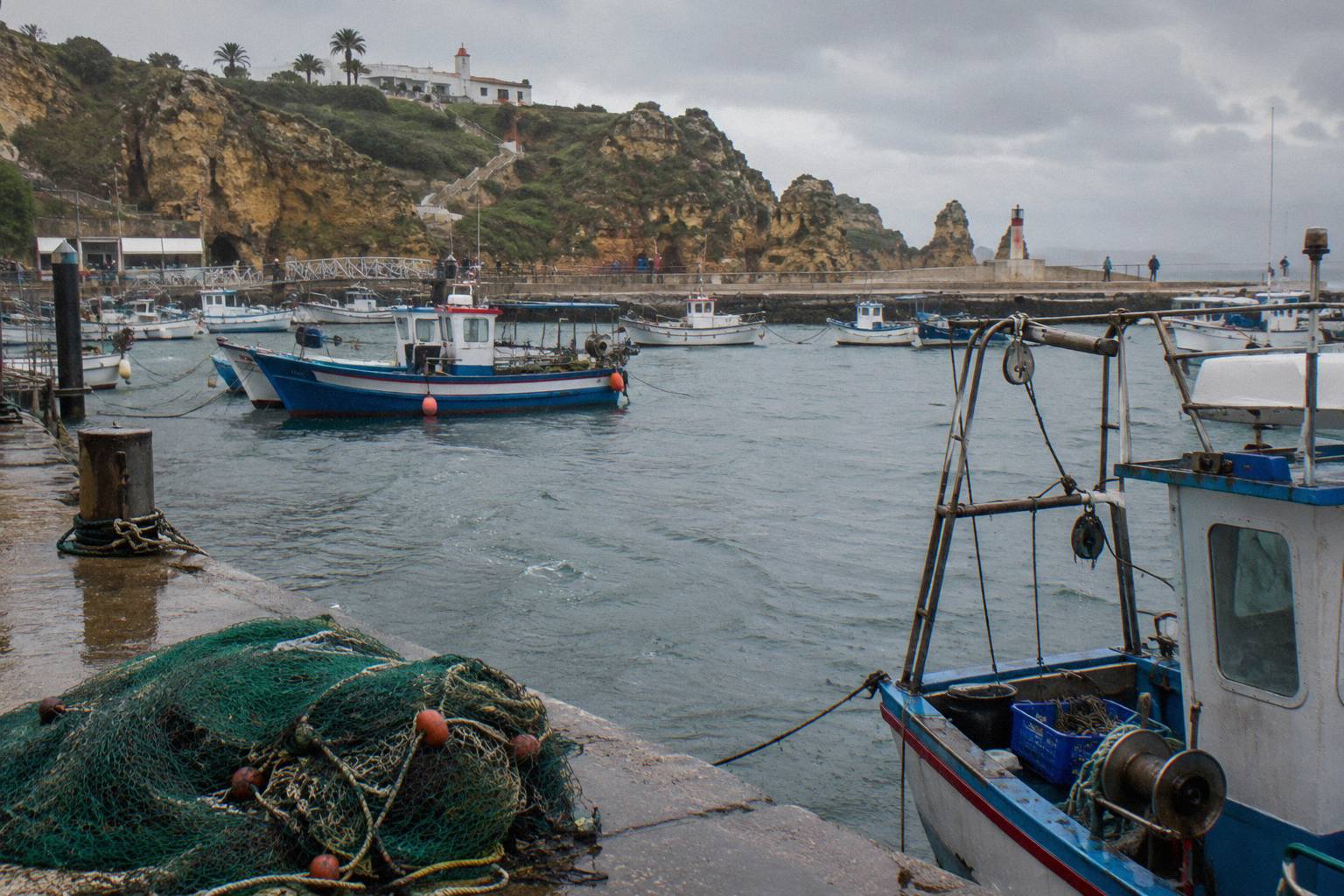
Ponta da Piedade itself, the ochre headland about 2 km from Lagos that every one of these trips sails toward, is described by Visit Algarve as full of grottos and rock stacks 'particularly attractive when seen from the sea'. Attractive from the sea, but only reachable from the sea when the sea allows it. That distinction is the whole subject of this article.
What Decides Whether A Lagos Grotto Trip Is Cancelled?
A grotto trip is cancelled when the skipper judges the swell, tide or wind unsafe, when a yellow maritime-agitation warning from IPMA is in force, or when too few guests book. Sea conditions, not a fixed calendar, decide whether boats go out, and every skipper at Lagos Marina makes that call on the morning of departure. There is no season in which a cancellation is impossible, and no week in which it is guaranteed.
The decision chain has three links. The first is the forecast: IPMA, the national sea and atmosphere institute, issues weather and sea warnings, and the second is the rulebook: the Capitania do Porto de Lagos, part of the national maritime authority, issues local navigation rules that operators must follow. The third is the skipper on the day, who reads both and looks at the water in front of the marina. All three have to agree before a boat clears the breakwater, and any one of them can stop it.
A municipal edital published in 2016 sets out the navigation framework for maritime-tourism traffic on this stretch of coast, and a later edital from 2023 adds the rules that matter most for kayakers and paddlers. Between them, they explain why a trip that ran yesterday can be cancelled today with the same forecast icon on your phone app: the icon is a summary, the rules are specific, and the skipper sees conditions the icon never will.
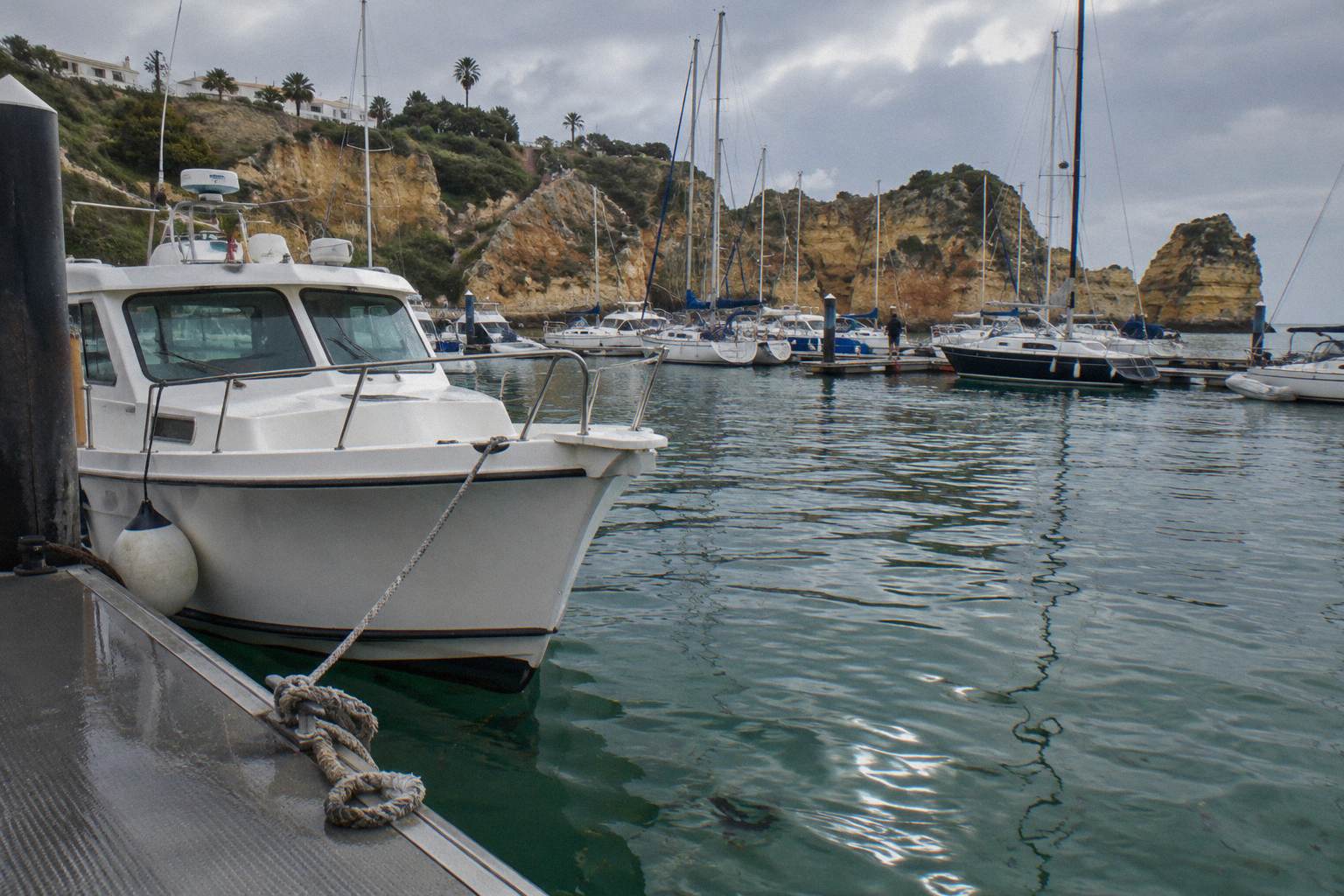
The operators themselves are regulated before they ever launch. Maritime-tourism operators must be registered in the national register of tourist-entertainment agents, and their boats are registered with the national maritime authorities. A licensed skipper cancelling a trip is not a business being awkward; it is the system working as designed, and the same registration and inspection regime is what makes the trips safe on the days they do run.
| Factor | Who issues or judges it | Effect on your trip |
|---|---|---|
| Yellow maritime-agitation warning | IPMA | Guided kayak and SUP tours do not run under it |
| Local navigation rules | Capitania do Porto de Lagos | Sets where and when boats may operate |
| Cliff-risk report | APA, consulted by operators | Caution required for boat traffic in and near caves |
| Swell and tide on the day | The skipper | Cave entry and even departure can be dropped |
| Too few guests booked | The operator | Stated only by Lagos Boat Tours: minimum of 2 guests |
One thing the research for this article could not find is an official maximum number of boats allowed inside a grotto at once. No such published figure exists, so any claim you see elsewhere about a boat-per-cave quota should be treated with suspicion. The caution requirement in the rules is real; a specific number attached to it is not.
Why Does A Yellow Warning Cancel Kayaks But Sometimes Not Boats?
The municipal rule is specific: guided kayak and stand-up paddle trips must not run under an IPMA yellow maritime-agitation warning, while powered boats are judged under the broader navigation rules and the skipper's assessment. That is why a kayak tour can be cancelled on a morning when small grotto boats still leave Lagos Marina.
The 2023 municipal edital sets conditions for guided paddle trips: lifejackets or flotation devices worn throughout, daytime only with good visibility, and a motorised support boat often required. It also prohibits the activity entirely under a yellow maritime-agitation warning. A paddler sits centimetres above the water with no hull, no freeboard and no engine, so the threshold for calling the whole activity off is lower than for a boat with a skipper at a throttle. The rule treats a swimmer in all but name as a swimmer.
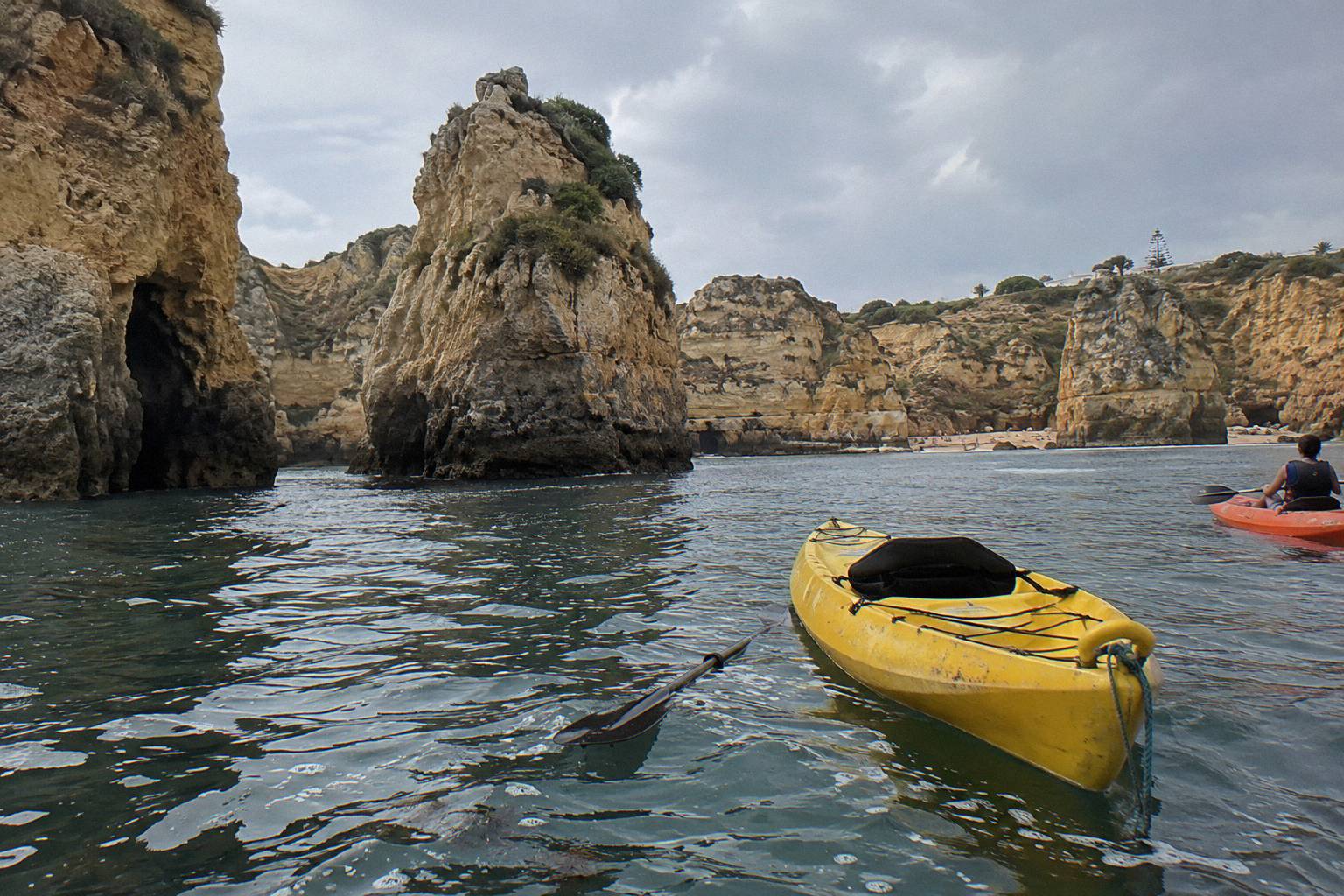
This has a practical consequence for anyone booked on one of the kayak products here. The Days Of Adventure Kayak With Support Catamaran, 4.9 from 1,271 reviews at from €30 per person, runs 2 hours 15 minutes with a catamaran shadowing the paddlers, but the support boat does not override the warning rule. When IPMA hoists yellow, the kayak portion does not happen, whatever the catamaran could safely do on its own. The same applies to the beach-start trip from Kayak Adventures Lagos and to every other guided paddle product listed on Ponta Da Piedade Tours.
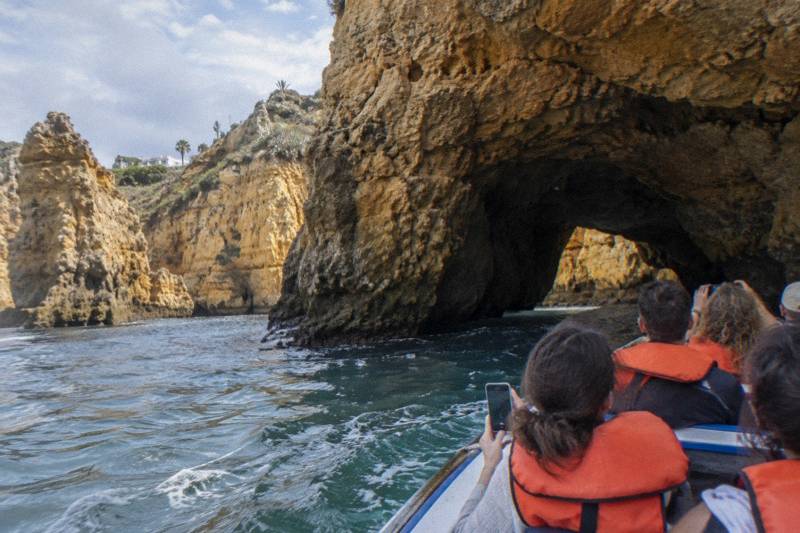
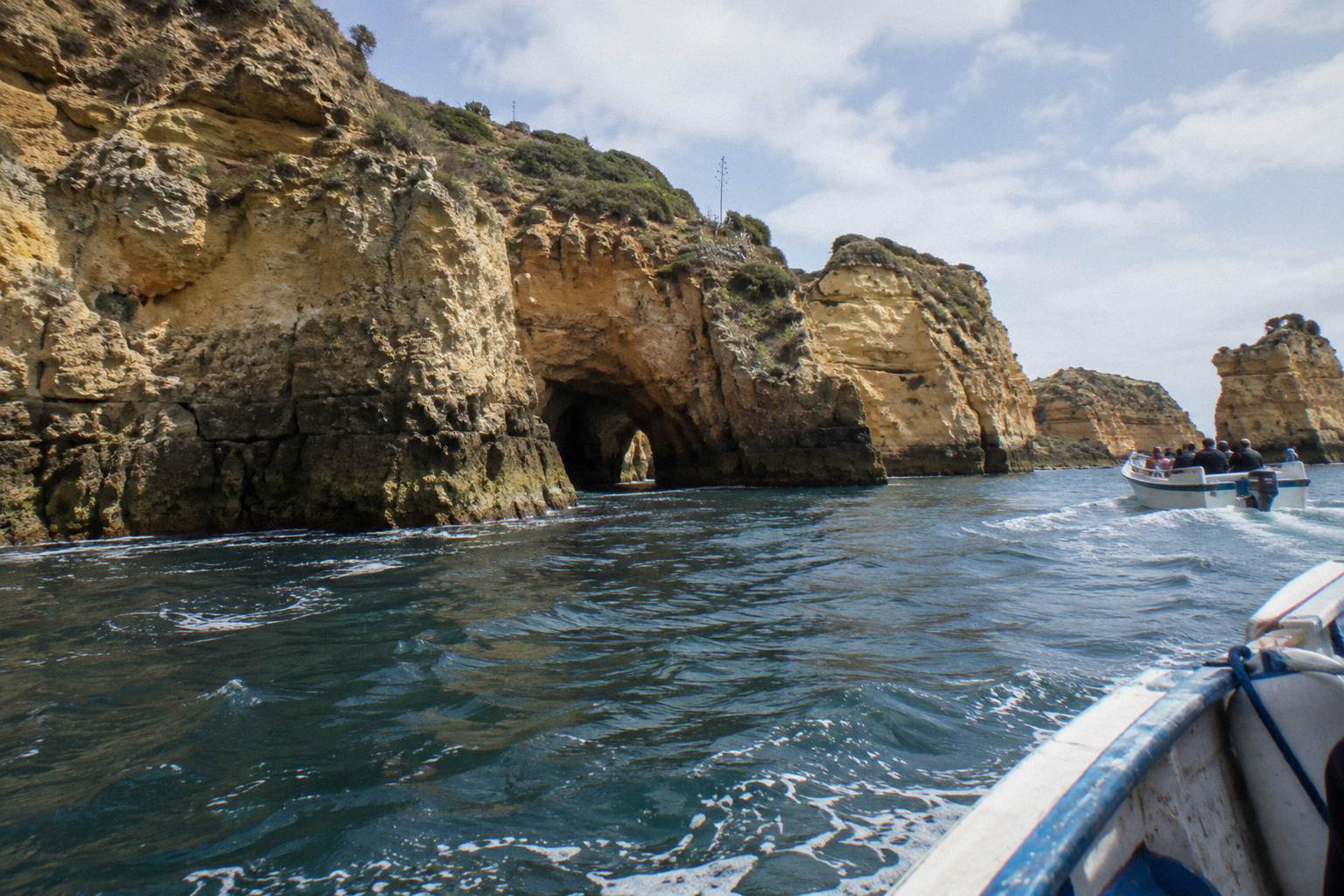
For powered grotto boats, the calculus is different but no less real. The small boats built to enter the caves need flat water inside the arches and passages; a modest swell that a catamaran shrugs off can slam a low boat against rock inside a grotto. So the boat may sail while the caves stay closed, which is why the phrase 'weather and tide permitting' is the only promise any operator here makes about cave entry. Bluefleet's own fleet page is explicit that its traditional grotto boats carry a maximum of 10 passengers precisely because the hull has to stay small enough for the passages, and a small hull is the first thing a swell punishes.
The Lagos Boat Tours Grotto Boat Trip, 5.0 from 385 reviews at from €25 per person, states its rule plainly: the programme can change with sea and weather, and the trip can also change if the minimum of 2 guests is not reached. That two-guest minimum is the only minimum-booking figure stated by any operator on this page, and it belongs to that one trip.
If you are weighing a paddle trip against a boat trip and flexibility matters, the boat versus kayak versus SUP comparison breaks down which format gives you the most chances of sailing across a typical week.
What Happens To Your Money When A Trip Is Cancelled?
Every one of the 25 trips covered on this site lists free cancellation up to 24 hours before the start, so if you cancel a day ahead you pay nothing. When the operator cancels, the operator's own weather rule applies, and no operator here publishes a refund timeline, a rebooking guarantee or a full-refund promise for weather.
Start with the part that is solid. The 24-hour free cancellation is a standard policy repeated on every product from the €16.20 Boatrips Inside The Grottos Boat Trip to the €850 Lagos Boat Charter private yacht. It means the risk of a bad forecast sitting a day or two out sits with you, and you can remove it yourself: cancel before the 24-hour mark and the money is not committed. That policy is not a favour granted by one generous operator; it is uniform across the entire set of trips here, which makes it the one number in this whole subject you can plan around with total confidence.
The murkier case is the operator-initiated cancellation. A trip cancelled for sea conditions, or for too few guests, is governed by the operator's own weather rule, and only Lagos Boat Tours states that rule in its product description. None of the twenty-five operators publishes a refund timeline, and none promises rebooking onto another date. The planning assumption, stated plainly: the operator's cancellation terms will be honoured, but the speed and the mechanism are theirs to define, and you should read them on the operator's page before paying.
| Situation | What the stated policy covers | What is not promised |
|---|---|---|
| You cancel more than 24 hours before start | Free cancellation on all 25 trips | Nothing to note; this is the firm case |
| You cancel inside 24 hours | Not stated on any trip line | No operator promises a refund here |
| Operator cancels for sea conditions | The operator's own weather rule applies | No refund timing, no rebooking, stated anywhere |
| Operator cancels for too few guests | Stated by Lagos Boat Tours only (minimum of 2) | No alternative-date promise stated |
| Trip runs but caves are skipped | 'Weather and tide permitting' is the standard wording | No operator promises entry into any cave |
The last row is the one that surprises people most. A trip that sails but stays outside the caves has not been cancelled; it has run as described, because every cave-entry product here qualifies entry with weather and tide. If entering a grotto is the entire point of your day, the guide to what a grotto trip actually includes sets out what is guaranteed, what is conditional, and what nobody should expect.
The featured small-boat trip from Bluefleet, 4.9 from 1,102 reviews at from €22.50 per person, makes a useful worked example: free cancellation up to 24 hours before the start is stated on it, cave entry is weather and tide permitting, and nothing about refunds for an operator cancellation is published beyond that. Check availability if you want that 24-hour escape hatch locked in for a date you are not sure about.
Why Is Cave Entry Only 'Weather And Tide Permitting'?
Entry into any cave at Ponta da Piedade depends on the swell, the tide and the skipper's judgement, and operators must also consult the annual APA geodynamic-risk report on cliffs and take caution with boat traffic in and near caves. No operator can promise entry into a specific grotto, and none of the trips here does.
Three separate forces have to line up before a boat noses into an arch. The swell must be low enough that the boat is not pitching inside a passage barely taller than its roof. The tide must be at a height that leaves clearance between water and rock, which is why the same grotto can be enterable at one hour and sealed the next. And the skipper must judge, on the spot, that the combination is safe, because the rules place that judgement on the licensed person at the wheel, nowhere else.
Behind the skipper sits a regulatory layer most visitors never hear about. Operators running cave visits must consult the annual APA report on geodynamic risk along the cliffs, and the municipal rules require caution for boat traffic in and near the caves between the port of Lagos and Praia do Porto de Mos. The cliffs are beautiful and they are also eroding: Visit Algarve describes carbonate rock being eaten into stacks, sinkholes, arches and caves, a process that does not pause for the tourist season, and the rock itself is Miocene in the municipality's wording.
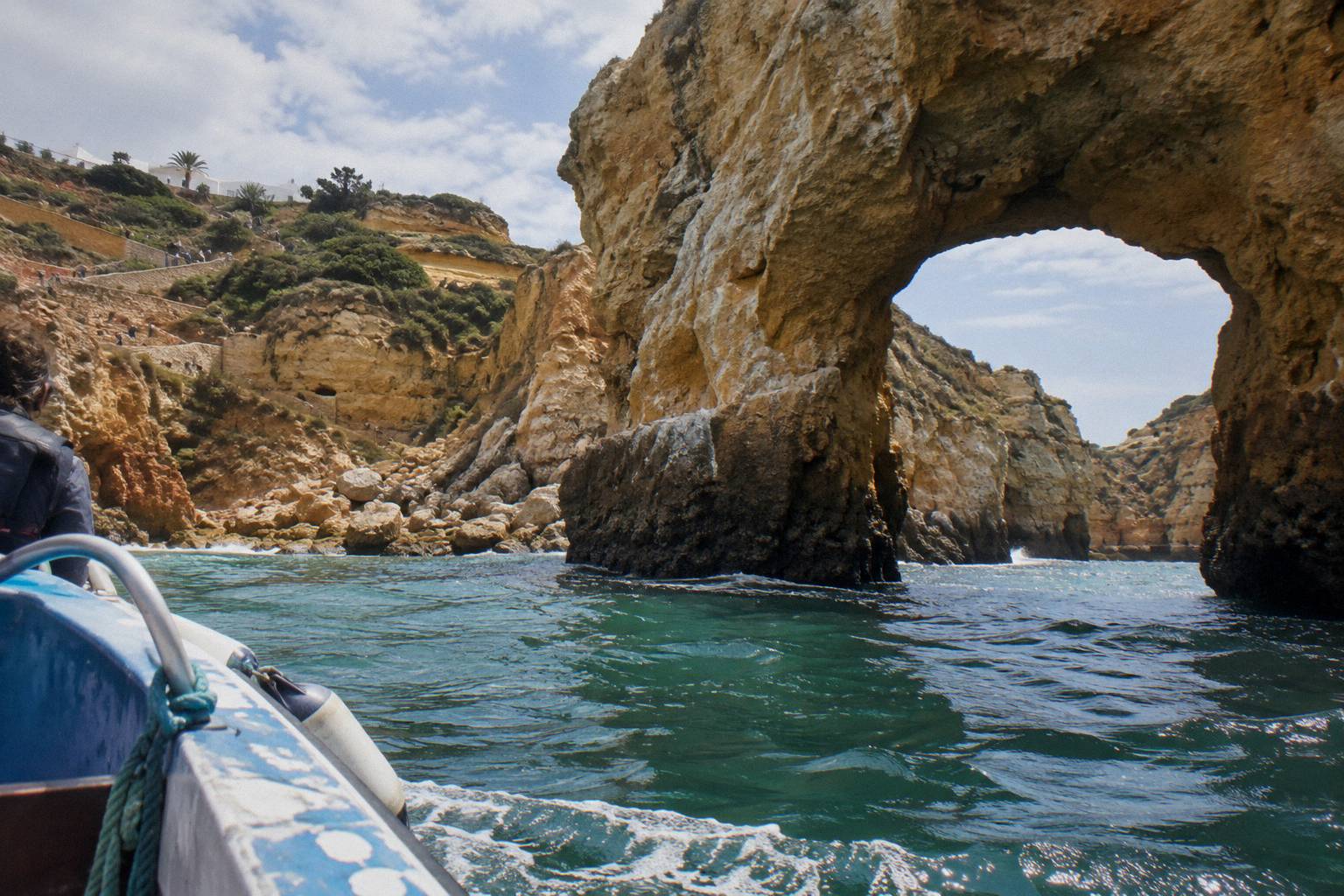
The named formations make the stakes concrete. Visit Algarve lists General De Gaulle, Chamine, Catedral, Belas-Artes, Camelo, Museu, Submarino, Cozinha and Gruta dos Amores as shapes seen from the boats, and Lagos Boat Tours names the Cathedral, the Kitchen, the Living Room and the Skull among the caves it visits, with passages called Siamese Twins and the Arch of Triumph. The municipality adds local names such as 'a balanca' (the scale), 'a cozinha' (the kitchen), 'o gigante' (the giant) and 'o sapato' (the shoe). Which of those a given trip passes or enters depends on the operator, the tide and the swell. Never book on the strength of one named cave; the sea may close it that morning.
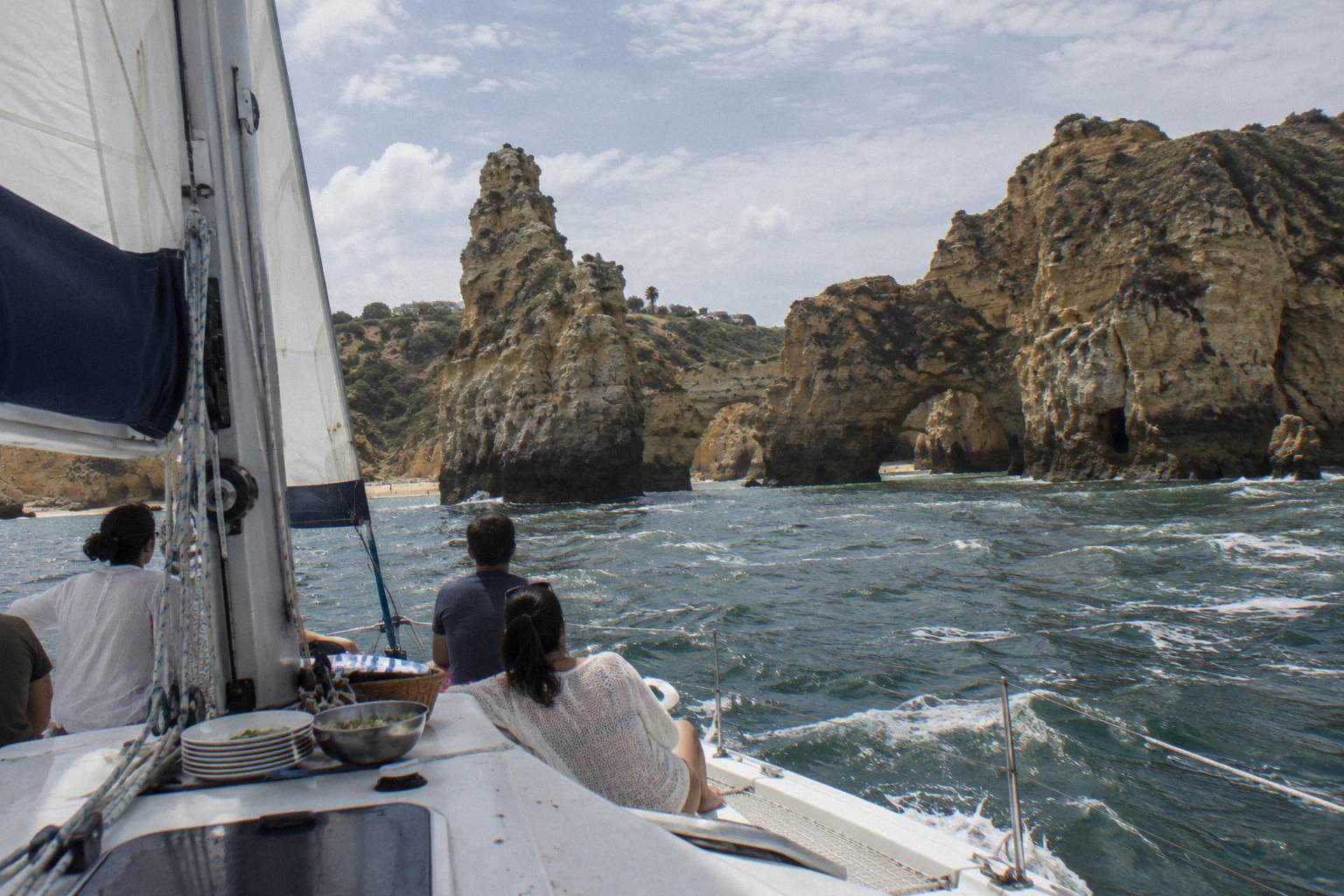
Afternoon wind and swell can change which caves a boat enters, the only safe generalisation about wind on this coast. A morning trip and an afternoon trip on the same day, with the same operator, can be entirely different experiences, and the morning is not automatically the calmer one; the skipper's call is.
Some products remove the question altogether. The Bluefleet Catamaran Cruise Views Only, 4.8 from 207 reviews at from €30 per person, is explicit: it does not enter the caves at all, so a cancelled cave entry is not a risk you are paying to take. The AlgarExperience Sunset Sailing Catamaran is views only too, with cave interiors visited only on a separate extra-fee support boat.
Two more cave-entry traps worth pinning down. The Lagos Boat Tours grotto trip explicitly bans leaving the boat or swimming, so even a successful entry is a look-don't-touch affair. And swim stops, where they exist, happen at sheltered anchorages outside the caves on catamaran, kayak-combo, sailing and private-boat products. Nobody swims inside a cave on any trip here. The caves and grottos from the water guide covers what the inside of a grotto actually looks like when you do get in.
What Do Sea And Air Conditions Look Like Through The Year?
NOAA satellite averages for 1991 to 2020 put the sea off Lagos between 15.2 °C in February and 20.0 °C in September, and the IPMA Faro climate normal gives mean daily maxima from 16.3 °C in January to 29.4 °C in July. Those figures describe comfort, not cancellations: sea conditions, not the calendar, decide whether a boat sails in any month.
The sea-surface averages reproduced by Portugal's tourism portal show a sea that warms slowly all summer and peaks after most visitors have gone home: 16.9 °C in May, 18.6 °C in June, 19.4 °C in July, 19.9 °C in August, 20.0 °C in September. September is the warmest month in the water, February the coldest at 15.2 °C. The measurements were taken 10 to 25 km offshore, so the water right under the cliffs can differ again.
The air side comes from the IPMA 1991 to 2020 climate normal for the Faro station, the nearest official normal; Lagos runs a little cooler in summer. Mean daily maximum: 16.3 °C in January, 20.7 °C in April, 26.8 °C in June, 29.4 °C in July, 26.4 °C in September, 19.6 °C in November. Days reaching 25 °C or more run 27.8 in July and 28.8 in August against 19.6 in September and 7.2 in October.
| Month | Mean daily max, Faro station (C) | Sea off Lagos, NOAA satellite averages (C) |
|---|---|---|
| January | 16.3 | 15.9 |
| February | 17.0 | 15.2 |
| March | 18.9 | 15.3 |
| April | 20.7 | 16.0 |
| May | 23.5 | 16.9 |
| June | 26.8 | 18.6 |
| July | 29.4 | 19.4 |
| August | 29.2 | 19.9 |
| September | 26.4 | 20.0 |
| October | 23.3 | 19.4 |
| November | 19.6 | 18.0 |
| December | 17.1 | 16.8 |
What this table cannot tell you is which month has the fewest cancellations, because no such statistic is published and none is claimed here. The sea's temperature says nothing about its agitation; a warm September swell can close caves that opened in a cool, flat February. For planning around the calendar rather than the sea state, the month-by-month trips guide is the companion piece to this one.
How Do You Build A Plan That Survives A Cancellation?
Give the sea two chances: book your grotto trip early in your stay with free cancellation up to 24 hours before the start, watch the IPMA forecast, and hold a backup slot later in the week plus one land-based alternative, because the cliffs can be walked when they cannot be sailed.
The single most effective tactic is timing your booking inside your holiday, not before it. Free cancellation up to 24 hours before the start applies to every trip here, so a booking made for day two of a five-day stay is an option, not a commitment. If the forecast turns, cancel inside the window and rebook for day four. The booking page confirms current prices and dates for each departure. Two chances at the same trip, with nothing paid twice, is the strongest position a visitor to Lagos can put themselves in.
The second tactic is choosing products whose promises survive bad weather. The views-only catamaran cannot lose its caves because it never promised them. The small boats keep their value even when caves close, since the passage along the cliffs past Praia da Batata, Praia do Pinhao and Praia do Dona Ana still runs whenever the sea allows a sail at all. And private boats give the skipper the most flexibility to reshape a route on the day: the Bluefleet Private Two-Hour Boat, 4.9 from 225 reviews at from €300, includes skipper, fuel, bottled water and snorkelling equipment, with the booking page showing what the price covers for your party.
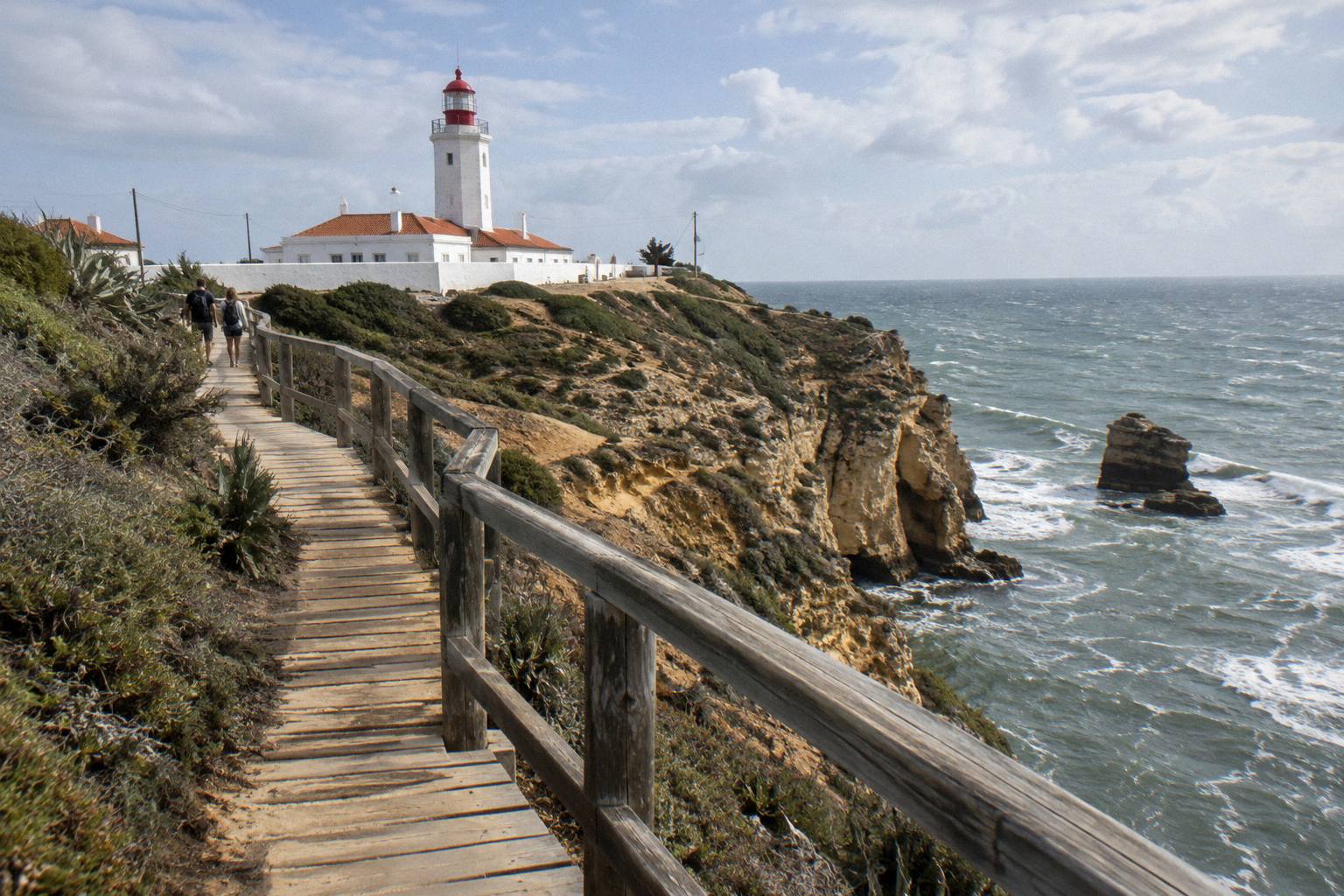
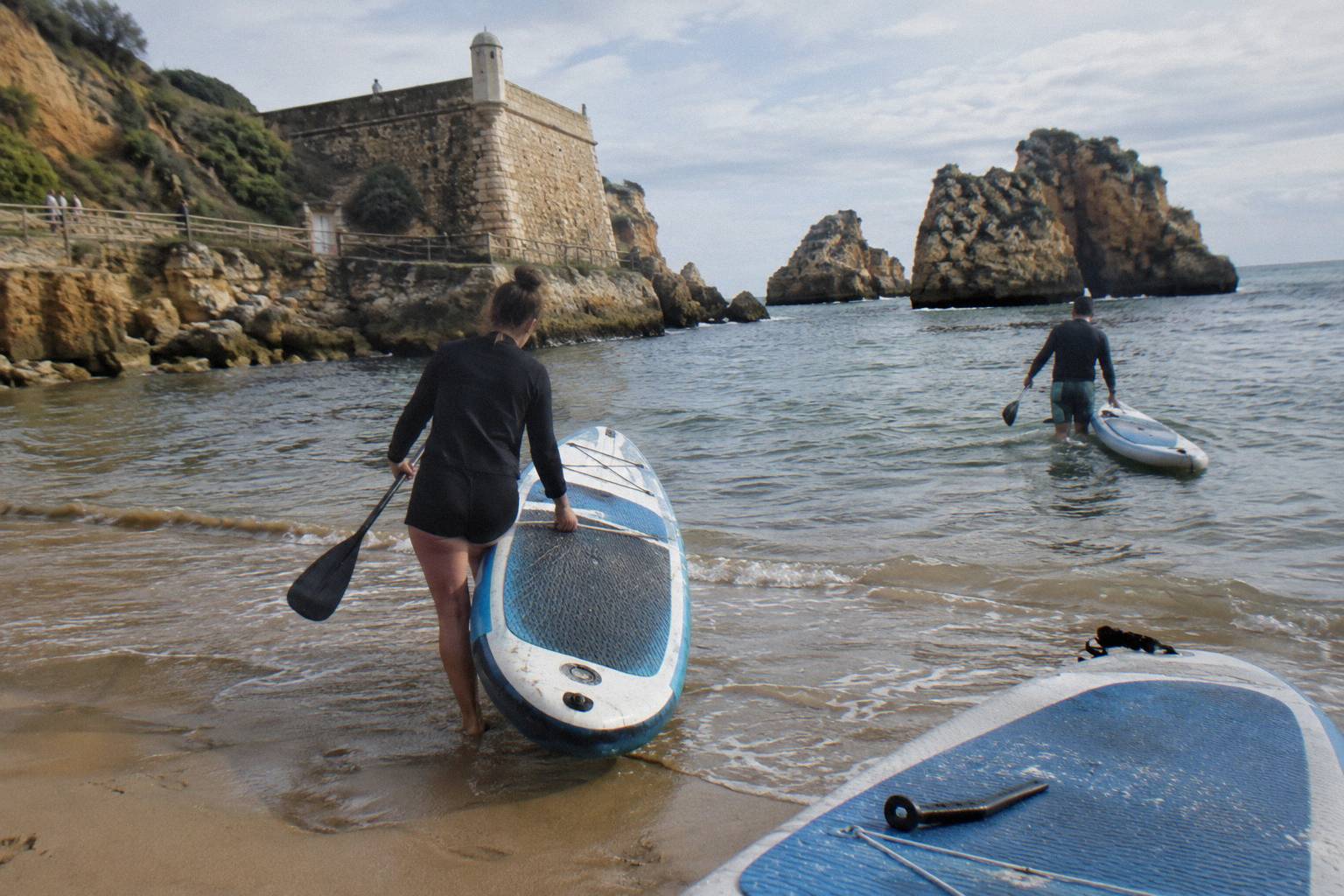
The land fallback is genuinely good, not a consolation prize. Lagos municipality describes the wooden boardwalks on the Ponta da Piedade cliffs as one of the best walking routes in the Algarve, with viewpoints between Praia do Pinhao and Praia do Canavial, passing Praia Dona Ana and the lighthouse. Near the lighthouse a long staircase leads down to the sea, the same cove where boatmen wait for passengers when the boats do run. The comparison of the headland on foot or by boat is covered in full elsewhere, but the short version: the cliffs work in any sea state, the boats do not.
A checklist for the week of your trip:
- Check the IPMA marine forecast for the Lagos coast each morning of your stay.
- If a yellow maritime-agitation warning is posted, expect paddle trips to be cancelled outright and boat trips to be trimmed or dropped.
- Cancel inside your free window yourself if the forecast is clearly wrong for your plans; do not wait for the operator.
- Keep one flexible day late in your stay as a rebooking slot.
- Hold the cliff boardwalk as the zero-cost backup that runs in every condition.
The pre-booking question has its own nuances, covered in whether to pre-book a grotto trip or walk up, and the same cancellation logic applies whether you booked months ahead or that morning: the sea gets the final word, and the 24-hour window is your lever on it.
Common Questions About Cancelled Lagos Grotto Trips
What Happens If My Lagos Boat Trip Is Cancelled For Weather?
The operator's own weather rule applies. Every trip listed here carries free cancellation up to 24 hours before the start, but no operator publishes a refund timeline, a rebooking promise or a full-refund guarantee for weather cancellations. Read the operator's cancellation terms on their page before paying.
Can I Cancel My Grotto Trip If The Forecast Looks Bad?
Yes, at no cost, up to 24 hours before the start. That policy is stated on all 25 trips covered here. Inside the 24-hour window no trip line states a refund, so the decision has to be made a full day ahead.
Do Kayak Tours Get Cancelled More Often Than Boat Tours?
No cancellation-rate statistic is published, so no frequency is claimed. What is certain is the rule: guided kayak and SUP tours must not run under an IPMA yellow maritime-agitation warning, while powered boats are judged by the skipper under navigation rules. On a yellow-warning day the paddle trip is off and the boat may still sail.
Will I Get My Money Back If The Caves Are Closed But The Boat Still Sails?
The trip has run as described. Every cave-entry product qualifies entry as weather and tide permitting, so a sail along the cliffs without entering the grottos is the trip operating normally, not a cancellation. If cave entry matters more than anything else, read what each trip promises before booking.
Who Actually Decides To Cancel A Boat Trip At Lagos Marina?
The licensed skipper on the day, guided by IPMA sea warnings, the local navigation rules issued by the Capitania do Porto de Lagos, and the municipal requirement to consult the APA cliff-risk report. Sea conditions, not a fixed calendar, make the decision.
Can A Trip Be Cancelled Because Too Few People Booked?
Yes, on at least one trip. Lagos Boat Tours states that its programme can change with sea and weather and if the minimum of 2 guests is not reached. No other operator here publishes a booking minimum; ask the operator if this matters to you.